



For more details on amane


- TOPICS
The MakerFujitake Knives

- Originally, the current chairman, Take Goto (left), operated a knife manufacturer called GT Hamono with his brother before becoming independent and founding the company in 1984. Due to the prevalence of the Goto surname in Gifu, he combined "Fuji" with "Take" to create the name "Fujitake Knives." In the 1990s, his son Tomohiro Goto (right) joined the company, and now various knives are manufactured with Tomohiro at the center.
TOPICS 01Knife making in Seki, a city of blades since the Kamakura period
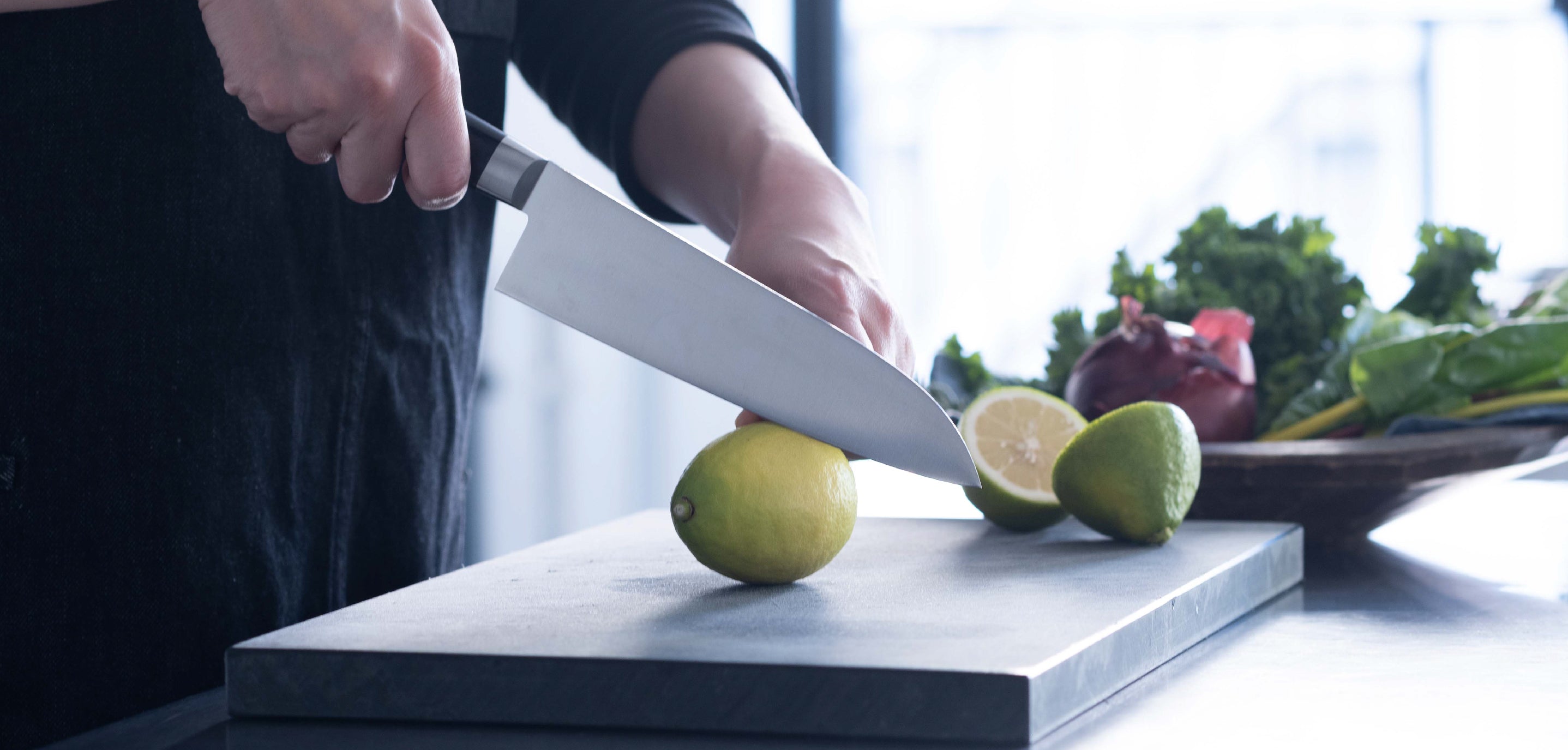
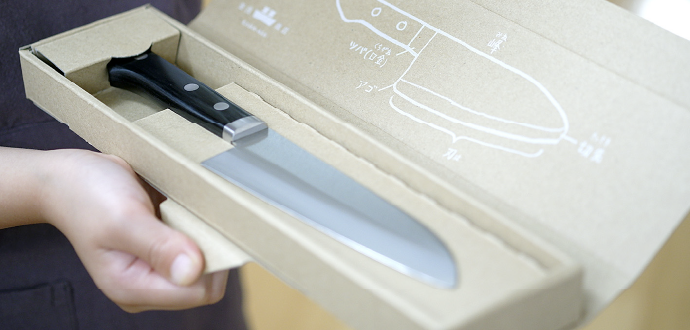
As you can see in Kamaasa Shoten's knife section, knives come in a variety of shapes and materials. There are significant differences between Japanese and Western knives, and the size and shape of the blade vary depending on the ingredients being cut. The original Western knife "amane," announced by Kamaasa Shoten, is not only sharp but also easy to grip, easy to sharpen, hygienic, and durable. The design, which is the epitome of simplicity, is intended to be universally loved for a long time without becoming boring.

Among the amane series, the chef's knife is particularly popular overseas and among professional chefs.
Kamaasa Shoten began trading with Fujitake over 30 years ago. The relationship deepened especially about 14 to 15 years ago. "Fujitake's work is meticulous, and the quality is excellent. Customers have increasingly said the same thing," recalls Kumazawa.

Kumazawa states, "Fujitake's knives are safe to sell." He has complete trust in the Goto family.
Seki City in Gifu Prefecture is one of Japan's three major knife production areas. The origin of swordsmithing in Seki dates back to the Kamakura period, when a swordsmith named Motomune moved there in the first year of the Kanki era (1229). At that time, Seki had abundant high-quality clay and water necessary for making Japanese swords, as well as pine charcoal for the furnace. It is said that Motomune's son, Kaneshige, apprenticed under the swordsmith Masamune in Kamakura, and upon returning home with his apprentice Shizusaburo Kanenari, the name of Seki's swordsmiths began to spread.
Seki's swordsmiths reached their peak during the Muromachi period, but as the demand for swords declined in the Edo period, their skills were repurposed for household blades such as kitchen knives, small knives, and scissors. This tradition continues today, making Gifu Prefecture the top knife production area in Japan. According to the 2020 industrial statistics survey, the shipment value of kitchen knives accounts for 57.4% of the national share. Even within Seki City, it occupies 46.2% of the national share.

A row of knives waiting for work. By the way, most knives made in Seki are stainless steel.
Unlike other knife production areas, Seki City's knife manufacturers do not have the image of blacksmiths, as stainless steel blades are the main focus. However, like other regions, the manufacturing processes such as pressing, heat treatment, grinding, polishing, and sharpening are carried out in a division of labor system. Among them, Fujitake is a company that prides itself on controlling quality by performing many processes in-house, such as polishing, distortion removal, finishing, and handle attachment. The philosophy instilled in Chairman Take Goto by his craftsman brother, "Don't chase after profit; make good things even if it takes time," is still upheld at Fujitake today.

On the first floor of the factory, men are engaged in polishing and sharpening tasks.
TOPICS 02Fujitake's focus on "how to make" rather than "what to use"
Currently, the company is led by the second-generation president, Tomohiro Goto. While adhering to the strict teachings of Take, he conducts flexible management that aligns with the times.
Kumazawa mentions that they have handled various knives from Fujitake, which, despite their simple appearance, receive frequent praise from customers saying, "It was great."
Ito agrees, saying that while different customers prioritize different aspects, those seeking sharpness, comfort during long-term use, or rationality in shape often receive recommendations for Fujitake's single-piece steel knives (made from a single piece of high-hardness metal). Many customers return for repeat purchases.
Kumazawa asks, "Including what we handle, how many types of steel does Fujitake currently use?"
Tomohiro responds, "V1, AUS-10, powdered high-speed steel, Damascus steel, special steel... The long seller is V1. When I joined, V10 didn't exist yet. But it's not just about having good steel. Nowadays, overseas customers are very knowledgeable and ask, 'What is the hardness?' But what's important is how to make it."

"It's no longer an era where just having V10 or being thin means it's good," says Tomohiro. He is constantly challenging himself to create the best knives.
TOPICS 03A knife aimed at being the "ultimate standard" that will never change
Kumazawa praises Fujitake's attitude. After discussing various topics, a trust relationship has developed between them, leading to a desire to create original quality knives together someday. Therefore, they wanted to use V10, which has very high hardness and durability, and long-lasting sharpness.
Tomohiro says, "When I received the proposal for 'amane,' I thought the theme of wanting many people to use it with affection for a long time was great. To achieve that, we simplified both the handle and the bolster. And what I thought was the strongest was Wada-kun's (note: General Manager Yoichi Wada) phrase 'ultimate standard.' At first glance, it may seem unremarkable, but once you use it, you can love it for a long time. I prefer to be called the ultimate standard rather than the highest quality. I think that's the greatest compliment."
Kumazawa responds, "I'm glad you feel that way!"
Ito adds, "By the way, during the 115th anniversary event of Kamaasa Shoten, we presented explanations about each production area to the customers who attended. At that time, 'amane' didn't exist yet, but I explained Seki's knives as 'standards that can be used forever.'"

Using a vertical water grinding machine, Fujitake performs a crucial process to create the ideal "thin clam blade." This requires delicate craftsmanship.
Kumazawa mentions another feature: the blade gradually thins from the spine to the edge, creating a gently curved cross-section that achieves both chip resistance and a pleasant cutting feel.
Tomohiro adds, "A clam blade is easy if it's thick. But what we aim for is a thin clam blade. It's not just about being thin; durability is also required. We do this carefully."

A cross-sectional diagram showing the difference between a regular blade and a clam blade due to sharpening in Western knives

The process of creating a sharp blade using a horizontally rotating whetstone called Hiramae is called "sharpening." In this process, the tip of the blade, which has been sharpened once, is sharpened again in a process called "small sharpening." This distributes the force on the blade edge, preventing chipping without losing sharpness.
Kumazawa states that for other parts, they incorporated the good aspects of Fujitake's knives. The stainless steel bolster and black handle are designed to be rounded for comfort during extended use.
Tomohiro remarks, "In terms of appearance, it can't compete with Damascus, which has a beautiful pattern. But for long-term use, this is better. Thanks to that, it's selling very well so far."
Kumazawa expresses, "I want to make this the world's best knife! I've been discussing this with the chairman. I believe 'amane' can achieve that."
Tomohiro adds, "At first, I didn't understand the meaning of 'amane.' But as soon as I heard it, I thought, 'Cool!' So now, I communicate with press and bolster manufacturers under the name 'amane.'"
TOPICS 04Craftsmen, users, and sellers. All are essential for "amane"
Ito notes that another characteristic of Fujitake is the high number of female craftsmen. How many employees do you have now?
Tomohiro replies, "10 people. Among them, 6 are women, and 3 are full-time employees. The handle attachment work is handled by 3 female part-timers, but since that alone is not enough, 2 employees also help out. They are all skilled, meticulous, and eager to learn. They immediately express a desire to try new things. The men are doing sharpening and other tasks on the first floor, but the women also say they want to do that. They can be noisy and complain, but they are reliable."

Drilling holes in the handle with a drill.

Attaching a stainless steel bolster. On the second floor, the women are active.
Kumazawa emphasizes that they are not just making knives. Thanks to craftsmen like Fujitake, they can deliver to customers. He believes they need to convey this properly to customers.
Tomohiro adds, "Kamaasa is honest (laughs). We are OEM, so we don't think about our name being mentioned. But it's nice to be recognized for the future. We also constantly think about the importance of valuing our craftsmen. We have meals with various craftsmen 5 to 6 times a month to discuss. We also take trips with craftsmen once a year, including Daisuke Takashima, the president of Midori Hamono Seisakusho."
Kumazawa concludes, "That's what makes Fujitake amazing. As sellers, we need to ensure we are looking in the same direction as everyone else."
Tomohiro adds, "That's why Ito-kun came here to study for a while. Now he understands what I taught him (laughs)."

Ito listens intently to Tomohiro's story. There is always more to learn to improve the knife section.
Ito states that the main purpose was to learn how to make Seki knives, but he also wanted to study sharpening. He realized that just observing for a day or two would only allow for a superficial understanding, so he thought that being involved in the work would help him remember better. He learned that the most important task at Fujitake is called "distortion removal." Before moving on to the next process, they thoroughly ensure that distorted knives are straightened. He was reminded that they do not shy away from time or effort in their work.
Tomohiro expresses that their biggest fear is losing customers who understand their value. If the seller's level rises, they can explain to customers. A person who can sharpen knives can also understand the quality of the knives. The persuasive power becomes significantly different.

Polishing the handle attached to the knife. They carefully polish in 7 stages to eliminate gaps between the metal and plywood parts. In the end, it shines beautifully.

The small logo carries the determination of Kamaasa and the thoughts of the makers.
Kumazawa mentions that "amane" has the Kamaasa Shoten logo on the back of the blade. Previously, the knives made by Fujitake did not have this. The chairman said, "Why don't you include it? Not including it is irresponsible," so this time they included it with a sense of responsibility and confidence, as well as a desire to sell it to the world.
Tomohiro adds, "In ten years, if foreign customers who are currently obsessed with Damascus say, 'Give me an amane,' that would be the best."
Kumazawa concludes, "Both Tomohiro and the chairman, as well as Daisuke from Midori Hamono, all want to spread and nurture 'amane.' I want to convey this 'ultimate standard' created together with everyone to as many people as possible. Thank you for your continued support!"

Located in the center of Seki City, where old houses remain, is "Fujitake Knives."
PRODUCTS amane


Written and edited by Murasaki Yamashita, photographed by Kamaasa Shoten


